





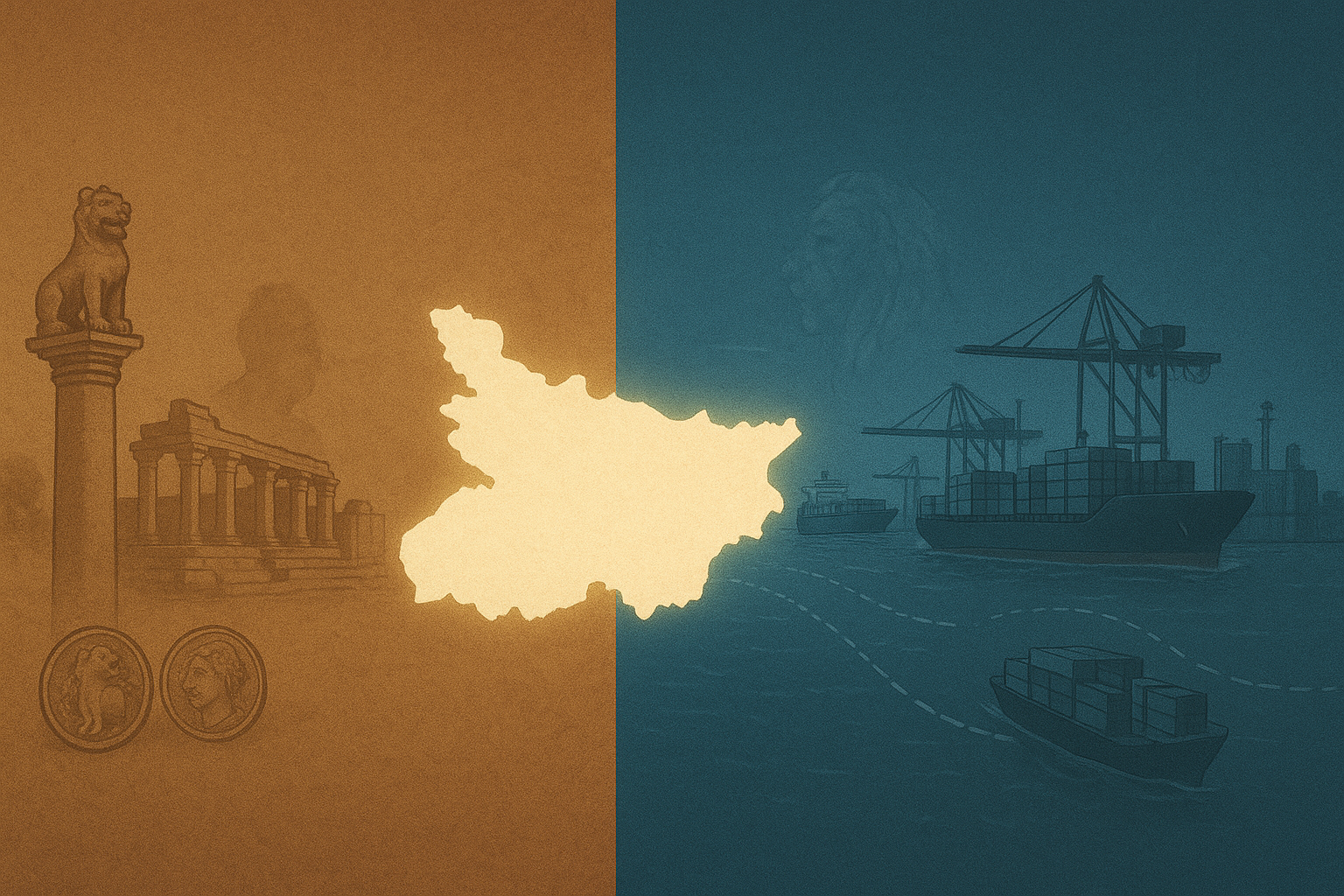
A few days ago, I came across an article in Foreign Affairs by S.C.M. Paine. In that article, she tried to explain the struggle for a new world order and argued that modern conflicts over the international system flow from a deeper, long-standing disagreement over the sources of power and prosperity. This struggle, as she explained, originates in geography, which has given rise to two antithetical outlooks: continental and maritime.
As per her, Continental powers treat land as the true currency of prosperity. Surrounded by multiple neighbours, they have historically seen conquest and military strength as essential for security and power. Maritime states, shielded by oceans, view commerce rather than territory as the foundation of wealth, preferring trade and prosperity-building over conquest.
But, since the World War II, this maritime paradigm has dominated the global order. Although Paine applied this framework to international relations, it also provides a compelling lens to understand Bihar’s decline within India.
Bihar as a continental power
For much of recorded history, the land today known as Bihar was a continental giant. Its geography had all the advantages and supported it to become a “continental” giant, a centre of power and prosperity in the subcontinent. Ancient empires such as the Mauryan and Gupta flourished here, projecting power across the subcontinent.
Land was the currency and Bihar was rich in it. It was a time when the continental paradigm was the dominant reality. That is why strategic thinkers like Chanakya suggested and encouraged the Vijigishu (read the emperor at Pataliputra) to conquer neighbouring kingdoms (Modelski), an approach which eventually led to the creation of a truly pan-subcontinental empire, the first great Empire of Indian History.
Even under Islamic and British rule too, the Gangetic heartland remained the economic core of this country, despite Britishers caused deindustrialisation. The Mughals relied heavily on the revenues of Bihar, adjoining areas and Bengal. In the continental paradigm, yet, this prosperity remained locked in the finite game of land-based conquest. However, this changed dramatically after WWII.
The Maritime Turn
After World War II, we witness a dramatic shift in dominant paradigm as maritime states prospered. The United States, UK, France and much of European countries which have vast oceanic coast eventually became the leader of this maritime paradigm.
Under this paradigm, the world increasingly focused on trade and commerce, which later culminated into globalisation. To safeguard this paradigm, countries which benefitted most from this, created a rules-based order and most countries of the world joined this paradigm as it reduced major conflicts and rewarded openness, mobility and secure oceanic trade giving rise to prosperity and stability. By this time, the oceans were no longer been viewed as barriers; rather, if I say it in PM Modi’s words (unsurprising given his own background as he comes from a maritime state)—“Oceans connect our world.”
By the time India achieved independence, this paradigm had become the norm. Independent India entered and accepted this world order with optimism. The then leaders of India, shaped by maritime thinking, pursued policies that privileged coastal states as it was way to prosperity. The Freight Equalisation Policy of 1952, though propagated as an instrument of balanced growth, was designed in a way that raw materials from mineral-rich Bihar could be transported cheaply to regions with maritime access.
Thus, the very logic which Paine identified globally that maritime preference for commerce over land can be seen replicated within India itself. In this process a once powerful region found itself hemmed by an institutional order designed to reward coastal integration with the world economy. This maritime paradigm produces an infinite-game dynamic, where transactions are mutually beneficial and wealth compounds across generations, leading a way to prosperity. But, for landlocked Bihar, tied to continental model, this new order proved disadvantageous.
The LPG Reform
The second major blow to this continental power came with LPG reform in 1991. As India integrated with the world economy—already shaped by the maritime paradigm—the logic of geography became more unforgiving. Except Delhi, FDI overwhelmingly flowed to states with maritime access as these states registered comparatively better economic growth promising better return for investment. It is estimated that approximately 25–20% of total FDI inflows went to Maharashtra, around 20% to Karnataka, and about 15–16% to Gujarat.
On a global level, the rules-based order created by maritime states(countries), aided by globalisation, rewarded them with prosperity. Institutions like the WTO and IMF, alongside security frameworks like NATO and the US military’s oceanic dominance, reinforced this position.
Post-independence, India privileged the infinite game (ever-increasing prosperity and compounding wealth) of the maritime paradigm. States with oceanic access such as Maharashtra, Gujarat, Karnataka and Tamilnadu saw their wealth compounding through stable trade. But this maritime paradigm proven disadvantageous for Bihar. Just as maritime powers built global institutions like the IMF and World Bank to privilege maritime logic, India’s policies like Freight Equalisation, SEZs, and FDI incentives institutionalised this maritime bias internally. Globalisation further amplified it, just as the post-war order advantaged countries with oceanic access. The liberalised Indian economy rewarded coastal states. IT hubs, SEZs, and export corridors flourished on the coasts, while Bihar remained a source of cheap labour.
The pattern mirrored Paine’s insight: maritime powers compounded wealth through commerce, while continental powers, unable to adapt, stagnated and remained poor.
Here is a table that compares the share of India's GDP held by Bihar and the coastal states Maharashtra, Gujarat, Karnataka, and Tamil Nadu from around 1960–61 (close to the independence period) to the present (2023–24). This table clearly shows that the share in India’s GDP as a percentage of coastal states either remained the same or increased, while Bihar’s declined significantly. This again proves the hypothesis.

India’s economic institutions still continue to privilege maritime regions. The Union government provides tax incentives for export zones, port-led industrialisation policies, and infrastructure corridors—all disproportionately favouring coastal states.
Bihar, bound within a constitutional and federal framework, cannot resort to continental paradigm by altering its geography. Unlike historic continental powers that pursued territorial expansion, Bihar cannot generate prosperity through conquest. Its capitulation to a maritime paradigm and dependence on central allocations further constrain its options.
The shift from continental power, which generated prosperity by political dominance and stability to the maritime paradigm, which the central government has steadfastly pursued, has had visible consequences. Bihar’s per capita income remains low and millions migrate to other states for jobs and livelihoods, often facing hardship and racism.

This maritime bias has shaped not only material outcomes but also political hierarchies too. Today, parties and individuals who have risen to power at the centre enjoy the backing of wealthy elites from maritime states, which has supported their political projects. One can argue that, in the current democratic setup, Bihar has significant parliamentary representation. However, it is evident that de-facto power still rests with a few individuals who themselves come from maritime state, while ministers from Bihar wield little to no influence despite being in the cabinet.
The marginalisation of Bihar is not merely an accident of underdevelopment; it is the outcome of a continental power trapped in a maritime order. Bihar’s current political leaders, despite commanding a large vote bank, are unable to secure structural redress from the centre.
However, because Bihar is a state of a Union unlike countries in the anarchic world order, it can seek compensation and help from the centre. Therefore, it is imperative that Bihar and central government must invest substantially in infrastructure in Bihar building corridors that connect it to national and global markets. High-speed rail, expressways and integrated logistics can reduce its effective distance from ports. Bihar can also harness the advantage of rivers. Riverine transport along the Ganga River and her tributaries can provide quasi-maritime connectivity.
The second thing is that Bihar’s leaders must consolidate power and influence at the centre, not merely as coalition partners but as active decision-makers. Without consolidation of political power at the centre, economic transformation will not occur. Bihar must also seek compensatory mechanisms within India’s constitutional and federal framework in the form of special packages and targeted industrial incentives as recompense for accepting a maritime bias for at least seven decades. Without active political influence at centre, Bihar will not be able to get sufficient resources necessary to overcome its disadvantage of being a landlocked state.
The third thing is human capital. Bihar’s greatest asset is its people. It needs to invest a lot in education and health. However, till then, we need to consolidate our connection with Biharis living outside Bihar. Due to outward migration, Biharis working in factories across India have gained what Dan Wang termed “process knowledge.” This is hands-on knowledge gained from experience—how to make things and how to make them better. Bihar should connect with its diaspora and, with investors, persuading them to build factories and industrial areas in Bihar, while compensating business owners to offset the maritime advantage.
Conclusion
People often ask why Bihar—once the land of empires, declined? To understand this, it is best to view Bihar’s decline through the lens of geography and the continental-maritime dichotomy. Bihar has been disadvantaged by a maritime paradigm that values oceanic commerce and connectivity over land. Central policies like freight equalisation and later liberalisation entrenched this bias, leaving Bihar weak and poor. Yet with wise policies and sufficient incentives to businesses, Bihar can overcome this challenge.





No comments yet. Be the first to comment!